

Stay comfortable. Save energy this winter.
Find simple tips, helpful tools, programs and rebates to lower your energy use.

How cold weather affects your energy use

Understanding winter energy rates

Manage your energy use and bill

Tips to reduce energy use

Winter safety tips
How the cold weather affects your usage
Cold weather plays a major role in increasing your energy use, which can have a big impact on your bill. Understand how:
During colder months, your heating system has to work harder and run longer to maintain the indoor temperature. It’s important to understand what’s a comfortable temperature for you and your family.
Cold weather means colder water entering your water heater, which requires more energy to heat it. That’s why the shower takes longer to get to that sweet spot.
Spending more (cozy!) time at home can lead to higher energy use for heating, lighting, and appliances. We also love to watch TV on a Sunday with a blanket and some hot cocoa!
Older or less efficient heating systems, as well as poor insulation or drafts around windows and doors, can cause your heating system to work harder.
Using space heaters can add significantly to your energy bill. A typical 1,500-watt space heater used for 8 hours a day can add around 360 kilowatt-hours (kWh) to your monthly bill. Believe us, we get it!
Understanding winter energy rates
Your bill is based on how much energy you use and also on the price of energy, which are the rates charged for that energy. Those rates can change during extreme weather.
Your bill has two main parts:
- Supply: the cost of the electricity or natural gas you use.
- Delivery: the cost of bringing that energy to your home or business.
Delivery rates are set by the Public Service Commission (PSC) and do not change often. Supply rates can go up or down based on market conditions and demand.
Supply prices have risen over the past years due to increasing consumption of electricity and natural gas. And weather played a major role last year: with the colder than normal weather we experienced, demand climbed even higher and pushed supply prices up during the season.
We don’t control supply prices. If we buy energy for you, we pass the cost on to you with no markup!
Support for the winter season

We help reduce the impact of changing electric supply prices by planning and purchasing energy in advance (if you purchase your energy supply through us). This helps smooth rate changes for Standard Service (SC1) customers. Customers on Day-Night (SC8) or Time-of-Use (SC12) rates may see supply costs variations more quickly as market prices change.

If you need financial assistance, visit our Help With Bill page, where you’ll find a variety of support programs.

To learn more about supply prices, explore our sample bill, visit our pricing page or watch this short video from the New York Independent Operator (NYISO).
Manage your energy usage and bill
We help you to keep track of your usage and manage your energy bill.
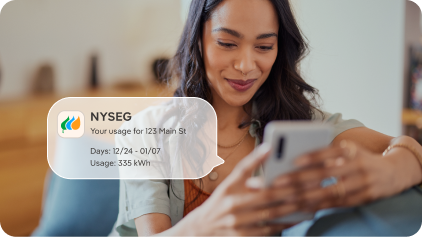
Alerts
Sign up for alerts to track you energy use, set up targets and get notified of big usage shifts. Stay informed during outages and winter storms.

Budget Billing
Enroll in Budget Billing to balance your energy costs throughout the year and avoid surprises during the heating season.

Energy Manager
With Energy Manager, you can: track your energy use down to the hour, see how your use compares to similar homes and get personalized tips to reduce your energy consumption.
Tips to reduce energy use
A few simple tweaks can make a big difference in your usage
According to the Department of Energy (DOE), lowering your thermostat 7° to 10°F for eight hours a day can help you save up to 10% a year on heating and cooling. In winter, keep it around 68°F when awake and lower when asleep or away.
Look for and seal any leaks in your duct work. A simple roll of duct tape from your local hardware store can do the trick!
Make sure to replace or clean your furnace filters when they get dirty or at least once a month to keep your system running efficiently.
Roll up a small rug or towel and place it across the bottom of your door to prevent cold air from sneaking in.
Close heat registers in rooms you’re not using, but ensure the temperature stays above freezing to protect your pipes.
Consider installing a programmable or Wi-Fi thermostat to automatically control your heating and save money by lowering the temperature when you’re not home (unless you have a heat pump). Check out our Smart Savings Rewards program and control the temperature at anytime, anywhere!
The DOE states that switching to a heat pump can cut electricity use by up to 75%. Learn more about heat pumps and enjoy our rebates at our NYS Clean Heat Rebate page.
Switch to high-efficiency LED lighting. The DOE states LEDs use 90% less energy than standard incandescent bulbs and last up to 25 times longer.
Turn off lights whenever you leave a room or don’t need them. Empty rooms don't need the lights on!
Always load the dishwasher to its full capacity. Choose the most energy-efficient drying option—heat dry is usually the least economical. For extra savings, skip the drying cycle and let dishes dry naturally. Turn off the drying cycle, open the dishwasher, and let the contents dry naturally.
Set your refrigerator to 38 to 40°F and your freezer to around 5°F. Remember, every time you open the fridge, about cold air escapes!
Use the oven window to check on your food instead of opening the door and letting heat escape. Remember: patience is a virtue!
Use advanced power strips to eliminate ‘standby’ power that many devices consume even when turned off.
Set your water heater to 120°F. Many are preset at 140°F, which usually uses more energy than necessary.

Don’t forget your holiday lights
Decorative lights are a great way to bring more joy to the season, but they can increase your energy use and create safety hazards. Learn more about it in our Festive Lights Page.
We’re here to help
If you need additional support during the winter, we offer a variety of assistance programs designed to help. Visit our Help With Bill page to learn more.
Understand your bill
Learn how your bill is calculated and explore the available electric and natural gas rates for you.
Winter safety tips
Learn what to do to keep you and your family safe this winter.
Snow and ice can interfere with electric and natural gas meters and regulators or make them harder to access during an emergency. Keep meters and regulators clear by gently removing snow with your hand or a broom, not a shovel. Do not push or pile snow around meters. Take care when using snow blowers or plows nearby to avoid damaging meters, regulators or piping.
Falling snow and ice from your roof can damage electric and natural gas meters or regulators. If your roof is being cleared, make sure your meter is protected from falling snow and ice and that snow or ice is not deposited on or around your metering equipment. Consider contacting a qualified roofing contractor to safely remove snow and ice above meters and regulators.
If you have natural gas equipment that vents outside through a sidewall, keep the vent clear of snow and ice. A blocked vent can cause equipment to shut down or malfunction and create a potentially hazardous condition, including a dangerous buildup of carbon monoxide.
Stay away from electrical equipment that is damaged, down or covered by fallen trees or debris. Never touch a downed power line or anything that may be in contact with it. Always assume a downed line is energized and dangerous.
If your natural gas meter becomes encased in ice or begins making an unusual noise, contact us at 800.572.1111.
If you smell an odor of natural gas, leave the area immediately, call 911 and then contact us at 800.572.1121.
Stress-free season
Whether you're hitting the slopes or staying in by the fire, our digital tools have you covered.

eBill
With our paperless eBill service, your energy bill arrives safely in your inbox — no snow boots required. Login now and go to ‘Preferences’.

AutoPay
AutoPay takes care of your bill automatically, so you can focus on what really matters - spending time with your loved ones. Login now and go to ‘Preferences’.

Mobile App
Check your bill, make payments and report outages — anytime, anywhere, even from the ski lodge.